Ever heard of agentic test automation? It's a new way of thinking about quality assurance, driven by AI. Instead of writing code, you simply state what you want to test in plain English, and a smart agent figures out how to actually do it in a browser. Think of it as replacing brittle, code-heavy scripts with something far more resilient and human-like.
Moving Beyond Brittle Scripts
If you're in an engineering or QA team, you know the pain all too well. You sink days into writing end-to-end (E2E) tests using frameworks like Cypress or Playwright, only to watch them shatter the moment a developer pushes a minor UI change. This endless loop of writing, fixing, and maintaining fragile test suites is a massive productivity killer.
Traditional test scripts are a bit like old-school factory robots. They can follow a rigid set of instructions perfectly, but if one little thing on the assembly line moves—even by a centimetre—the whole process grinds to a halt. The robot has no clue what its goal is; it only knows the exact, hard-coded steps. A script told to click('#submit-button-v2') fails instantly if a developer changes that ID to click('#submit-button-final'), even though any human would adapt without a second thought.
The Agentic Alternative: A Human with a Checklist
Now, imagine you gave that same task to a human tester armed with a simple checklist. Their instruction isn't to click a specific CSS selector; it's to "click the submit button." If that button's colour, text, or underlying code changes, they can still find it and click it because they understand the intent.
That’s the core idea behind agentic test automation. It flips the script entirely. Instead of telling the machine how to perform each step, you just tell it what you want to achieve.
By focusing on user intent rather than technical implementation details, agentic automation builds resilience directly into the testing process. It adapts to change, just like a person would, dramatically reducing the time spent on maintenance.
This shift isn't just a nice-to-have; it's becoming critical. In the ANZ region, executives are already moving investments away from traditional system upgrades and towards agentic AI, driven by intense pressure to show ROI. Research shows that a staggering 23% of workforce time is lost to system maintenance, which kills innovation. For smaller engineering teams, that kind of inefficiency just isn't sustainable—they simply can't afford the bloated maintenance cycles that brittle Cypress or Playwright tests demand.
Understanding the Key Differences
The contrast between the two approaches is pretty stark. Traditional methods demand specialised coding skills and constant upkeep. Agentic automation, on the other hand, opens up the process, letting anyone who understands the product contribute to its quality. For a deeper dive, check out our guide on AI-based test automation.
To really see the difference, a side-by-side comparison makes it clear.
Traditional Scripting vs Agentic Automation
Here's a high-level look at how these two philosophies stack up against each other. It really comes down to a fundamental difference in approach, maintenance overhead, and the skills you need on your team.
| Aspect | Traditional Automation (Cypress/Playwright) | Agentic Test Automation (e2eAgent.io) |
|---|---|---|
| Test Creation | Writing explicit code and CSS/XPath selectors. | Describing user scenarios in plain English. |
| Resilience | Brittle; breaks with minor UI or code changes. | Adaptive; understands intent and finds elements contextually. |
| Maintenance | High; requires constant script updates and fixes. | Low; tests self-heal by adapting to most UI tweaks. |
| Required Skills | Requires software development/coding expertise. | Anyone can write tests; no coding needed. |
| Core Focus | Defines the how (the exact steps to take). | Defines the what (the goal to achieve). |
As you can see, the focus shifts from the rigid mechanics of how to the flexible, goal-oriented question of what the user is trying to accomplish. This simple change is what makes all the difference in building a test suite that lasts.
How AI Agents Understand and Execute Tests
To really get your head around agentic test automation, it helps to look under the bonnet and see how the AI "thinks". It’s less like a rigid script and more like giving directions to a clever human. If that person hits a roadblock, they’ll figure out a different route. An AI agent applies that same kind of smart, adaptive logic to your application’s user interface.
This process isn't some black-box magic; it's a very logical loop of understanding, acting, and observing. It all starts with figuring out what you, the user, are actually trying to achieve.
From Plain English to User Intent
The first step is all about interpretation. When you write a test case in plain English, like "Click the login button, enter '[email protected]' into the email field, and then click 'Continue'," a Large Language Model (LLM) gets to work. Its job is to break down your instruction and pinpoint the core user intent.
The LLM doesn't just see a string of words; it understands the concepts behind them. It knows that "login button," "email field," and "continue" are all standard parts of a login flow. From this, it builds a mental model of the goal: someone wants to log into an account with a specific email. This initial understanding is absolutely critical because it sets the context for every single action that follows.
This approach is worlds away from brittle, selector-based scripting, which only cares about the how (the specific code) rather than the what (the user's goal).
The flowchart below shows this shift from a fragile, code-heavy process to a much more resilient, intent-driven one.
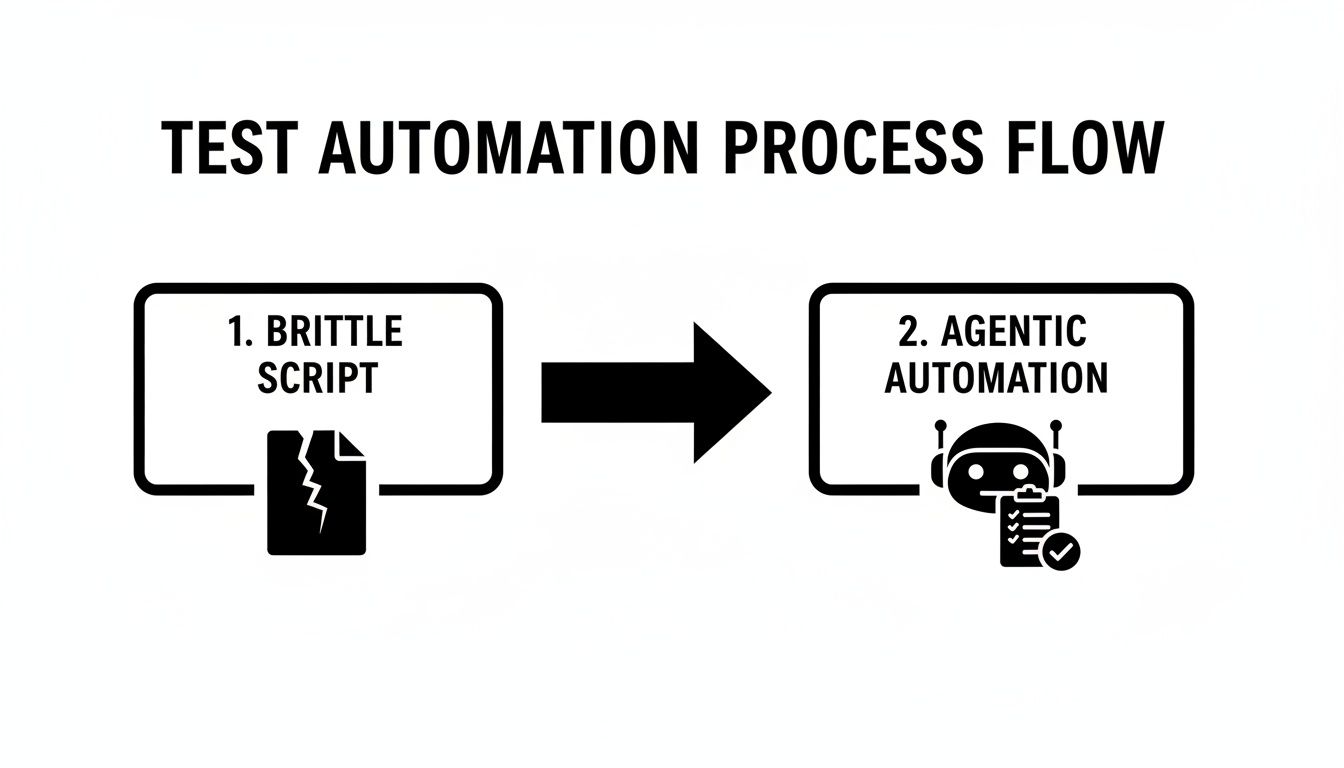
As you can see, agentic automation effectively bypasses that fragile code layer. Instead, the AI interacts directly with the application based on the user's goals, making the whole process far more durable.
Interacting with the Live Application
Once the agent understands your goal, it starts interacting with your live application’s Document Object Model (DOM). Think of the DOM as the architectural blueprint of your webpage. The agent scans this blueprint to find the elements it needs to get the job done.
This is where the agent's intelligence really comes into play. Instead of looking for a hard-coded ID like #login-btn-123, it searches for an element that contextually fits the description "login button." It might look for a <button> tag with the text "Login," or maybe an element with other attributes that strongly suggest its purpose. This contextual awareness is what makes the test so incredibly resilient to change.
An agent's ability to locate elements based on intent is its greatest strength. A developer can change element IDs, update CSS classes, or even restructure the HTML, and the agent will still find the correct button because it understands the goal, not just the code.
This intelligent interaction is what really sets it apart from traditional tools. A coded script would break the moment a developer made a minor tweak, but the AI agent just adapts and carries on, saving countless hours of frustrating maintenance.
The Feedback Loop: Action and Observation
Agentic test automation isn't a one-shot deal; it runs on a continuous feedback loop. This iterative cycle of acting, observing, and deciding allows the agent to navigate even complex user journeys with real precision.
Here’s a simple breakdown of how it works:
- Perform an Action: Based on the user's instructions, the agent takes a single step, like clicking a button or typing into a form.
- Observe the Result: After the action, the agent re-scans the DOM to see what changed. Did a new page load? Did a success message appear? Did an error pop up?
- Decide the Next Step: The agent compares this outcome with the original goal. If everything looks right, it moves on to the next instruction. If something unexpected happened, it can try to self-correct or, if necessary, report a failure.
This constant cross-referencing keeps the test firmly on track. The agent is always asking itself, "Did what just happened move me closer to the user's goal?" This methodical process demystifies the AI, showing it for what it is: a logical system that follows instructions and adapts to real-world conditions.
Despite its potential, adoption in Australia is surprisingly low, with only 11% of organisations reporting they have AI agents in production. This often comes down to the difficulty in proving ROI. It creates a massive opportunity for focused solutions like agentic testing to deliver clear, measurable value and help bridge the gap from pilot projects to full-scale use, as you can see from other tech trend insights.
Putting Agentic Automation into Practice
Theory is one thing, but seeing agentic test automation in action is what really makes the concept click. Let's move from the abstract to the practical and look at how a tool like e2eAgent.io tackles real-world testing scenarios with nothing but plain-English instructions.
These examples show you just how easy it is to test critical user flows without writing a single line of code. The AI agent simply reads your instructions, navigates a live web application, and checks the results, pretty much exactly how a human tester would.
Scenario 1: SaaS User Signup and Login
For any SaaS application, a smooth signup and login process is the front door. If it breaks, you lose customers before they even get a chance to see your product. Testing this flow manually after every deployment is a grind, and traditional scripted tests are notoriously brittle.
Here’s how an agentic approach completely changes the game. You just provide a clear, step-by-step instruction covering the entire user journey.
Plain-English Prompt: Navigate to the signup page. Fill in the name field with "Alex Taylor", the email field with a unique email address, and the password field with "SecurePassword123!". Click the 'Create Account' button. Then, go to the login page, enter the same email and password, and click 'Log In'. Finally, verify that the text "Welcome, Alex!" is visible on the dashboard.
From just one simple prompt, the AI agent handles the whole sequence—creating a user, logging back in, and confirming everything worked perfectly.
Scenario 2: E-commerce Add to Cart and Checkout
The path from finding a product to checking out is the absolute lifeblood of an e-commerce site. Any bug along this path directly costs you money. Agentic testing helps you make sure this critical revenue stream always stays open.
This scenario involves navigating categories, picking a product, and starting the checkout process. If you want to dive deeper into how AI is shaking up this space, check out our guide on E2E AI.
Plain-English Prompt: Go to the "Electronics" category. Find the product named "Wireless Noise-Cancelling Headphones" and click on it. Click the "Add to Cart" button. Once the item is in the cart, click the cart icon, and then click the "Proceed to Checkout" button. Verify that the checkout page title is "Secure Checkout".
This single test validates a whole series of interactions, confirming the core commercial function of your site is solid. The agent understands concepts like "category" and "cart icon," finding them contextually even if their underlying design or code changes.
Here’s what a live test run looks like in e2eAgent.io. You can see the agent processing each step and interacting with the browser in real-time.

This split-screen view, with the agent’s actions on the left and the live browser on the right, makes it incredibly easy to follow along and spot any issues immediately.
Scenario 3: Verifying a Contact Form Submission
Contact forms are a classic lead-generation tool, but they have a nasty habit of failing silently. A broken form means lost opportunities. A quick agentic test is all it takes to make sure your communication channels are always open for business.
This test is simple but absolutely crucial. It verifies that a user can submit their information and get the right confirmation message back.
Plain-English Prompt: Navigate to the contact page. Fill in the 'Your Name' field with "Jamie Lee", the 'Email Address' field with "[email protected]", and the 'Message' field with "This is a test message.". Click the "Submit" button and verify that the success message "Thank you for your message!" appears on the page.
Key Takeaway: These examples prove that agentic test automation isn't just about clicking buttons. It's about validating entire user journeys and business-critical workflows using the same natural language your team uses to talk about features.
This approach gives everyone on the team—from developers to product managers—the power to ensure quality without needing to become automation engineers. It makes thorough testing accessible, fast, and, most importantly, resilient to change.
The Business Case for Agentic Test Automation
While the technical side of agentic automation is fascinating, the real story is the strategic impact it has on the business. Ditching brittle, code-heavy test suites isn't just a shiny engineering upgrade—it's a direct investment in your team's speed, efficiency, and ability to innovate. For any team that needs to move fast, this translates into a clear return on investment (ROI) that everyone from the CFO to the Head of Product can get behind.
The first and most obvious win is the massive drop in test maintenance. Traditional test suites are notorious time-sinks, often forcing your best developers to spend more time fixing broken tests than they do building new features. Agentic test automation completely flips that script.
Because the AI agents understand the intent behind a user action rather than just a brittle selector, they adapt to most UI changes automatically. A button's colour, ID, or position can change, but the agent still knows what it's for and gets the job done. This self-healing ability frees up your most expensive talent from the mind-numbing grind of test upkeep.
Accelerating Release Cycles with Trustworthy Feedback
Fast, reliable feedback is the lifeblood of any modern CI/CD pipeline. Flaky tests just create noise, kill confidence in your automation suite, and bring deployments to a screeching halt while developers try to figure out what's a real bug and what's a false alarm.
Agentic testing gives you a much clearer, more dependable signal. When a test fails, you can be pretty confident it's a genuine problem with the application, not just a broken script. This high-fidelity feedback loop lets teams merge and deploy with real confidence, cranking up release velocity without compromising on quality.
By cutting out the constant noise of flaky tests, agentic automation turns your test suite from a frustrating bottleneck into a genuine quality gate. It empowers teams to ship features faster, react to market changes, and ultimately, stay ahead of the competition.
The results we're seeing are already dramatic. Australian enterprises embracing this approach are reporting incredible improvements, slashing their cycle times by 50–80% and cutting the need for manual intervention by up to 70%. As detailed in recent analyses of enterprise AI adoption, these systems are gaining board-level approval because they deliver payback in weeks, not years, with minimal risk and built-in compliance.
The measurable improvements teams can expect after adopting an agentic testing approach are quite significant and impact different roles in tangible ways.
Measurable Impact on Development Teams
| Metric | Typical Improvement Range | Primary Beneficiary |
|---|---|---|
| Test Maintenance Effort | 60-90% Reduction | Engineering / QA Teams |
| Release Cycle Time | 50-80% Reduction | Product & Development Teams |
| New Test Creation Speed | 5-10x Faster | Product Managers, QA, Devs |
| Flaky Test Incidents | 80-95% Reduction | DevOps / SRE |
| Manual QA Intervention | 60-70% Reduction | Manual QA Testers |
These numbers highlight how the benefits ripple across the entire organisation, from freeing up engineers to improving the predictability of product delivery.
Democratising Quality Across the Entire Team
Perhaps the most powerful business impact is how agentic test automation breaks down the old silos around quality assurance. For years, test automation was a specialised skill, a walled garden accessible only to engineers who could code. This created a disconnect, separating the people who knew the product inside-out (product managers, designers, manual testers) from the actual process of ensuring its quality.
With tests written in plain English, that barrier simply vanishes.
- Product Managers can now write tests themselves to validate that a new feature meets their exact requirements.
- Manual QA Testers can translate their deep product knowledge directly into robust, automated regression suites.
- Customer Support Teams can even create tests to replicate and verify fixes for customer-reported bugs.
This inclusive approach creates a powerful sense of shared ownership over quality. It ensures testing is driven by real, user-centric scenarios, not just by the underlying technical details. When anyone who understands the user journey can contribute to automation, the whole team becomes more aligned and effective. Quality stops being a final checkpoint and starts being a continuous, collaborative habit—and that's a true competitive advantage.
Integrating Agentic Tests into Your CI/CD Pipeline
Bringing agentic test automation into your workflow doesn't mean you have to rip out everything you've built. Think of it less like a massive overhaul and more like a strategic upgrade for your existing CI/CD pipeline, making it faster, smarter, and far more reliable. The real goal here is to plug in these intelligent tests to act as a trustworthy quality gate—one that gives you a clear signal, not just the usual noise from flaky scripts.
This process is all about enhancing the workflows your team already knows and uses. By introducing agentic tests gradually, you can show their value right away and build momentum, turning your test suite from a maintenance headache into a genuine asset.
A Phased Migration Strategy
Jumping in headfirst with any new technology can feel overwhelming. A much smarter approach is to adopt agentic automation in small, manageable steps, proving its worth along the way. This minimises risk and helps your team get comfortable and confident with the new approach.
The best place to start? Your most problematic tests. We all have them—the brittle, high-impact ones that seem to break if someone even looks at them funny and soak up all the maintenance time.
- Identify High-Impact, Brittle Tests: Start by pinpointing the top 3-5 end-to-end tests in your current suite that fail most often because of minor UI tweaks. These are usually your core user journeys like logging in, signing up, or going through the checkout process.
- Convert and Compare: Next, recreate these exact tests using plain-English instructions in a platform like e2eAgent.io. For a few release cycles, run both the old, brittle script and the new agentic test in parallel. This side-by-side comparison will quickly prove just how much more resilient and low-maintenance the agentic approach is.
- Expand Incrementally: Once you've got some clear wins on the board, you can start converting more tests. Prioritise the ones that cover your most critical application features. This phased rollout makes for a smooth transition and gives your team time to adapt.
By targeting the most painful parts of your test suite first, you can secure quick wins that justify the shift. This creates a compelling internal case study, making it easier to get buy-in from the entire engineering organisation for a full migration.
This strategy ensures that every step forward delivers a tangible improvement to your development workflow. You can learn more about how to choose the right tools for this journey by exploring our comparison of modern AI testing tools.
Connecting to Modern DevOps Workflows
For any new tool to stick, it has to fit seamlessly into your existing pipeline. Modern agentic platforms are built for this, designed to plug straight into the CI/CD tools your team already uses every day, whether that’s GitHub Actions, GitLab CI, or Jenkins.
Typically, the integration is as simple as adding a new step to your CI configuration file. This step tells your pipeline to trigger the agentic test suite automatically whenever new code is pushed or a pull request is created.
Example Integration Points:
- GitHub Actions: Add a workflow step that calls the e2eAgent.io API to run a specific test suite. The results are then sent straight back to GitHub, marking the check as a pass or fail on the pull request.
- GitLab CI/CD: In much the same way, a job in your
.gitlab-ci.ymlfile can trigger the tests on every commit to a feature branch. This is a great way to stop buggy code from ever making its way into your main branch. - Jenkins: A post-build action in your Jenkins pipeline can kick off the agentic tests, ensuring every successful build is automatically validated against your key user flows.
Because these tests provide such a clear and reliable pass/fail signal, they become a quality gate you can actually depend on. This gives your team the confidence to merge and deploy more often, knowing that a green build means the core functionality really is working as it should. The result is a faster, more resilient pipeline that helps you accelerate your release cycle without cutting corners on quality.
Where Is All This AI-Driven Quality Heading?
Adopting agentic test automation isn't just a quick fix for today's flaky tests; it's the first real step into a much smarter future for software quality. We're on the cusp of a shift away from simply telling a machine what to click. Instead, we're moving towards a world where an AI actively partners with us to make sure our applications are solid, dependable, and a pleasure to use. This isn't just an upgrade—it's a complete rethink of what quality assurance can be.
The next logical leap is AI-driven test generation. Think about an agent that does more than just follow a checklist. Imagine it intelligently exploring your application all on its own. By understanding how real people use your app and grasping its structure, these future agents could autonomously hunt down edge cases and uncover bugs that even the most meticulous human tester might overlook. They'll be writing new, relevant test scenarios for you.
From Brittle to Self-Improving
And it doesn't stop there. The idea of "self-healing" tests is about to get a major upgrade. Sure, today's agentic tests are smart enough to handle minor UI tweaks, but the next generation will be in a different league entirely.
The real game-changer isn't just having tests that don't break; it's having tests that actively learn and get better over time. An agent won't just adapt to a relocated button—it might even suggest you rephrase your test description to be clearer and more efficient.
This creates an incredible feedback loop. With every test run, the AI learns. It will start spotting patterns in failures and suggest improvements not only to the tests themselves but maybe even to the application's user experience. The agent evolves from a simple task-doer into a proactive quality expert on your team.
Setting the Stage for Autonomous Quality
This long-term vision makes it clear why agentic automation is such a critical move right now. By getting on board with this technology, teams aren't just putting out the daily fires of test maintenance. They're building the foundations and skills for a future where a huge chunk of quality assurance happens autonomously.
This change will free up your team to:
- Find Unknown Risks: Let the AI uncover bugs in user flows you hadn't even considered testing.
- Sharpen Your Test Suites: Have the AI prune pointless tests and recommend new ones with more impact.
- Focus on What Matters: Liberate human creativity to tackle complex problems and build great features.
The whole journey begins by swapping out fragile, code-heavy scripts for simple, plain-English instructions. Taking that step puts your team right at the front of a massive shift in our industry. The path forward is clear: from automated execution to intelligent exploration, and ultimately, to autonomous quality. The future of testing is already taking shape, and now is the time to be part of it.
Frequently Asked Questions
Whenever a new way of doing things comes along, it’s natural to have questions. As more teams start looking into agentic test automation, a few common themes pop up around how reliable it is, what it can actually do, and who on the team can use it. Let's tackle some of the big ones.
How Reliable Is This Compared to Normal Coded Tests?
This is a big one. Agentic test automation is built from the ground up to be far more resilient than the traditional coded tests most of us are used to. Think about it: a standard test script breaks the second a developer renames a CSS class or an ID. It's brittle by nature.
AI agents, on the other hand, don't rely on brittle selectors. They understand the intent behind the test, looking for elements on the page just like a human would—by their context and appearance. This single change drastically cuts down on the 'flakiness' that makes so many test suites a nightmare to maintain. You end up with a CI/CD pipeline you can actually trust, where a failed test almost always signals a real bug, not just another broken script.
Can It Handle Genuinely Complex User Journeys?
Absolutely. In fact, this is where agentic platforms really come into their own. They are more than capable of navigating tricky, multi-step scenarios that cross different pages, user states, and even browser tabs.
You can lay out an entire end-to-end journey in a single, easy-to-read instruction. A real-world example might look something like this:
- Sign up for a brand new user account.
- Check for the verification email and click the link.
- Log back in with the newly created credentials.
- Search for a product, add a few different sizes to the shopping cart.
- Go through the entire multi-page checkout process to completion.
The AI agent keeps track of the context from start to finish, making sure each step is completed and verified before it moves on to the next.
Is This Approach Secure for Our Sensitive Applications?
Security is non-negotiable, and any serious agentic testing platform will have it baked into its core design. Tests typically run in isolated, sandboxed browser environments that are spun up just for the test run and completely destroyed the moment it's finished.
The key thing to remember is that an agentic tool interacts with your application just like a real user does—from the outside. It doesn't need special hooks into your backend code, direct access to your databases, or a free pass through your internal infrastructure. This helps you maintain a solid security posture.
As always, when you're looking at any tool, make sure it meets strict data privacy and security standards to keep your application and its data safe.
What Kind of Skills Do We Need to Write These Tests?
Here’s the best part: you don't have to be a developer. If you can clearly explain the steps a user needs to take in your application, you have all the skills you need to write a powerful agentic test.
This opens the door for so many more people on the team to get involved in building out test coverage. Your manual QA testers, product managers, and even business analysts can turn their deep product knowledge directly into reliable automated tests. It’s a great way to build a real, team-wide culture of quality.
Ready to stop fixing brittle scripts and start shipping faster? With e2eAgent.io, you just describe what to test in plain English, and our AI agent handles the rest. Start your free trial today and see how resilient your testing can be.