
The modern software development lifecycle demands unprecedented speed, but traditional test automation often struggles to keep pace. Writing and maintaining brittle test scripts consumes valuable engineering resources, slows down release cycles, and can become a significant bottleneck for teams shipping frequently. This is the core problem that ai testing tools are designed to solve. By integrating machine learning and artificial intelligence, these platforms streamline test creation, improve test stability, and drastically reduce the manual effort required for maintenance.
This comprehensive guide is built for product teams, QA leads, and developers who need to implement more efficient and resilient testing strategies. We've moved beyond generic marketing copy to provide a detailed, practical evaluation of the top AI-driven testing solutions available today. You won't find vague feature lists here. Instead, you'll get a clear analysis of how each tool actually works, its ideal use cases, and honest insights into its limitations.
Our goal is to help you cut through the noise and identify the right tool for your specific needs. Each entry includes:
- A concise summary of the tool's core function.
- Key feature analysis focusing on practical application.
- Implementation and integration notes to understand the setup process.
- Direct links and screenshots for a clear visual reference.
We will also explore a real-world test scenario, demonstrating how an AI agent like e2eAgent.io can execute a test from a plain-English prompt. This resource is your direct path to finding, evaluating, and successfully piloting the best ai testing tools to accelerate your development pipeline and enhance your product quality.
1. e2eAgent.io
e2eAgent.io distinguishes itself as a premier choice among AI testing tools by fundamentally changing how teams approach end-to-end (E2E) testing. Instead of requiring engineers to write and meticulously maintain complex scripts in frameworks like Playwright or Cypress, e2eAgent.io employs an AI agent that executes test scenarios described in plain, natural English. This approach significantly lowers the barrier to entry for comprehensive test automation.
Product teams can simply provide instructions such as, "Sign up with the email [email protected], create a new project named 'Omega Launch', and then verify it appears on the main dashboard." The agent interprets these commands and autonomously executes them within a real Chromium browser, providing a true representation of the user experience.
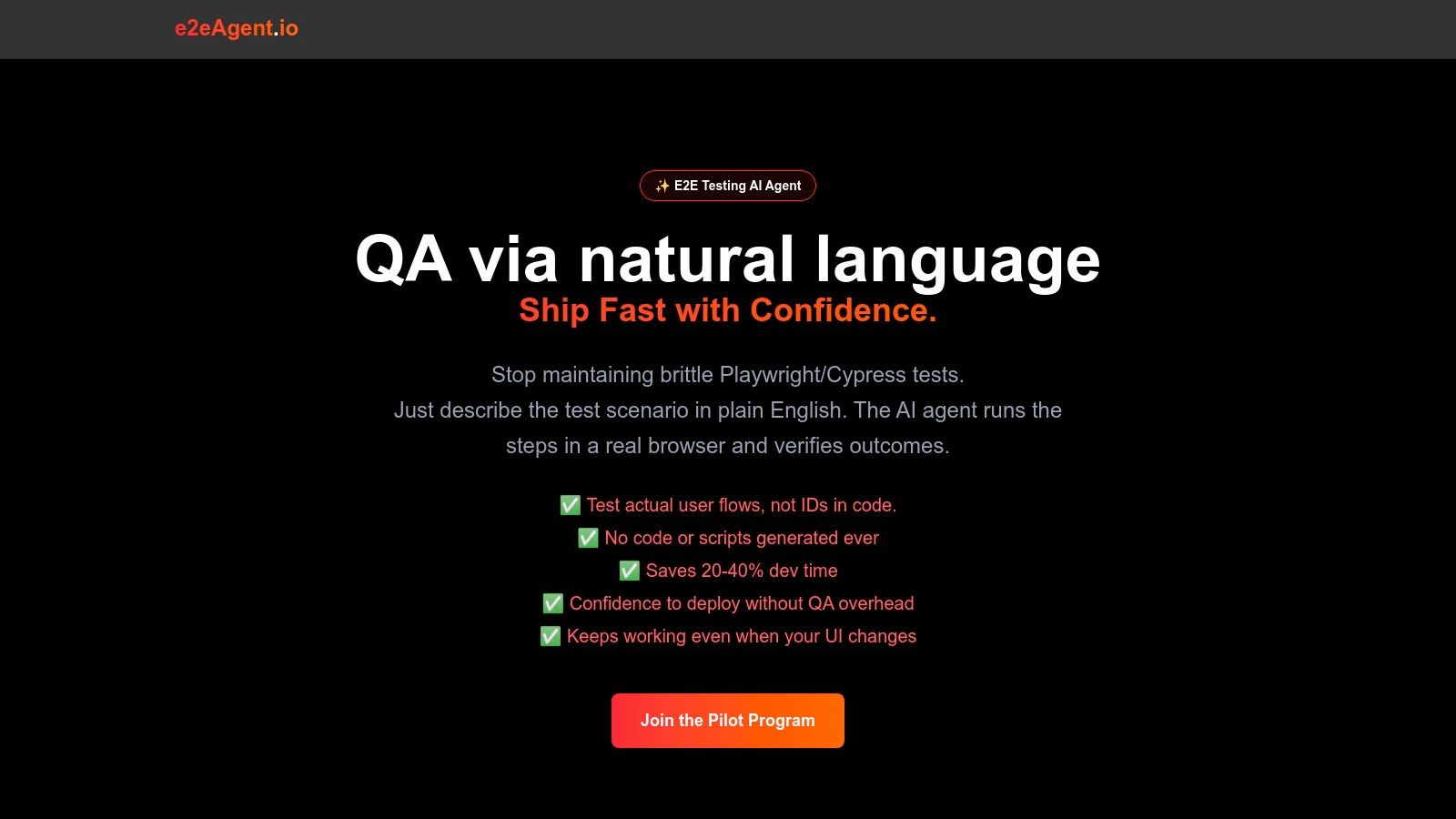
Core Differentiators and Use Cases
What truly sets e2eAgent.io apart is its resilience to minor UI changes, a common source of failure for traditional, selector-based test suites. The AI focuses on the user’s goal rather than the specific DOM structure, drastically reducing the time spent fixing brittle tests. This makes it an ideal solution for fast-moving startups and SaaS teams who need to ship features quickly without accumulating technical debt in their QA processes.
- Ideal Use Case: A small engineering team wants to ensure their core user journeys, like user registration or a checkout process, are stable before every deployment. They can describe these flows in English and integrate the resulting tests into their GitHub Actions pipeline for automated validation.
- Key Benefit: The platform produces rich, verifiable artifacts for each test run, including full video recordings, screenshots, and structured JSON outputs. These machine-readable summaries are designed for seamless integration into CI/CD pipelines such as GitLab CI, Jenkins, and CircleCI, providing clear pass/fail signals to developers.
Practical Considerations
Currently, access to the platform is managed through a Pilot Program and waitlist, as public pricing and self-service options are not yet available. This may be a consideration for teams needing immediate, production-ready solutions with defined SLAs. Additionally, its browser support is presently focused on Chromium, with Firefox and WebKit support planned for the future. While the AI is highly capable, some complex or ambiguous edge cases may still benefit from human review.
Pros:
- No-Code Test Creation: Write tests in plain English, eliminating script maintenance.
- Real-Browser Execution: Ensures tests accurately reflect real user interactions.
- Robust to UI Changes: AI-driven approach minimises flaky tests caused by minor code changes.
- CI/CD Friendly: Structured outputs and rich artifacts integrate easily into DevOps pipelines.
Cons:
- Waitlist Access: Not yet a self-service product, which may slow initial adoption.
- Chromium-Only: Browser support is currently limited.
- AI Interpretation: Novel or highly complex scenarios might occasionally require clarification.
For teams looking to reclaim significant developer hours and build a reliable, low-maintenance testing process, you can explore the platform's innovative approach and join the e2eAgent.io Pilot Program.
2. Applitools
Applitools has established itself as a leader in AI-powered visual regression testing, but its platform extends into autonomous, natural-language-based test creation. Its core strength lies in its Visual AI, called "Eyes," which intelligently identifies meaningful visual differences between application versions while ignoring minor, insignificant pixel changes that often cause flaky tests. This makes it one of the most reliable ai testing tools for teams prioritising a pixel-perfect user experience across a multitude of devices and browsers.
The platform also features an Autonomous component that can generate and self-heal test scripts from plain-English descriptions, lowering the barrier to entry for test automation. With over 30 SDKs, Applitools integrates seamlessly into existing testing frameworks like Cypress, Playwright, and Selenium, allowing teams to augment their current functional tests with powerful visual validation rather than replacing their entire stack.
Key Considerations
- Best Suited For: Teams that cannot afford visual regressions in user-facing applications and organisations looking to empower manual QA with AI-driven test authoring. Its cross-browser and device testing capabilities are critical for brands with a wide user base.
- Pricing Model: Applitools uses a "test-unit" capacity model. Pricing scales based on the volume of visual checkpoints you run, which requires careful planning and budgeting to avoid unexpected costs. However, paid plans include unlimited users, which encourages broad adoption across development and QA teams.
- Implementation Tip: Start by integrating Applitools Eyes into a small but critical user flow within your existing test suite. This allows you to demonstrate the value of visual AI in catching bugs that functional tests miss, without a major upfront process overhaul.
Website: https://applitools.com/
3. mabl
mabl offers a low-code, unified platform that leverages generative AI to simplify test automation across web, mobile, and API interfaces. It’s designed for teams who want to accelerate testing without a steep learning curve, combining intelligent, self-healing tests with comprehensive diagnostic data. This approach positions mabl as one of the more accessible ai testing tools for organisations looking to broaden their quality assurance coverage and empower testers of all skill levels.
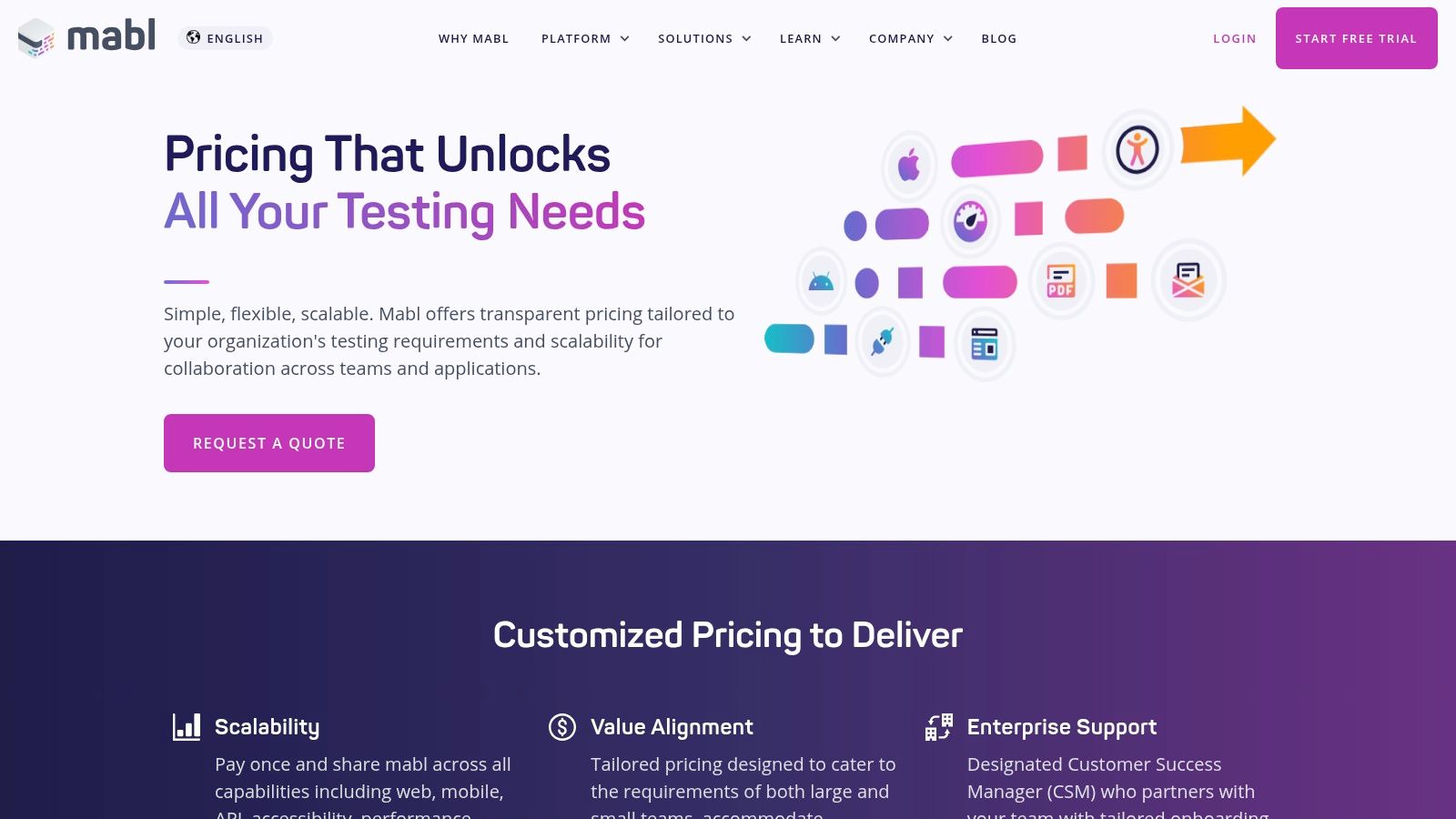
The platform's core strength is its auto-healing capability, where AI automatically updates tests when it detects application changes, significantly reducing maintenance overhead. With features like cross-browser testing, accessibility checks, and performance metrics rolled into a single solution, mabl supports a holistic approach to quality. Its GenAI features also assist in authoring tests, allowing teams to move faster from test creation to execution. For those new to automated checks, it’s helpful to understand their role in the development lifecycle; you can learn more about what functional testing is to build a solid foundation.
Key Considerations
- Best Suited For: Teams transitioning from manual to automated testing, and organisations that need a unified platform to cover various test types (UI, API, mobile) without managing multiple tools. Its excellent onboarding support makes it ideal for smaller QA teams.
- Pricing Model: mabl uses a quote-based model, and its packaging is designed to scale with team growth. The inclusion of unlimited local and CI/CD runs in its plans is a significant advantage, promoting frequent testing without fear of hitting usage limits.
- Implementation Tip: Start by using mabl's browser recorder on a key user journey. Let its AI create the initial test steps and then explore the auto-healing feature by making a minor UI change in a staging environment to see the test adapt automatically.
Website: https://www.mabl.com/pricing?utm_source=openai
4. Functionize
Functionize is an enterprise-grade, cloud-based platform that leverages AI for test creation, maintenance, and orchestration. It is designed for large-scale quality assurance operations, using natural language processing (NLP) to allow users to write tests in plain English while its deep-learning engine handles the underlying automation. A key differentiator is its focus on intelligent test orchestration and detailed analytics, providing insights into test suite health and application quality over time. This makes it one of the more comprehensive ai testing tools for organisations with complex testing needs and mature DevOps practices.
The platform's Adaptive Event Analysis technology is central to its self-healing capabilities, which intelligently updates tests when it detects changes in the application's UI, such as renamed element IDs or altered selectors. This significantly reduces the time teams spend on test maintenance. Functionize also offers add-ons like TestGPT for generative test creation and advanced controls for administration and data retention, catering to the governance requirements of larger enterprises.
Key Considerations
- Best Suited For: Large enterprises and QA teams that need a scalable, low-code solution with robust governance, detailed analytics, and advanced test orchestration capabilities. Its NLP-based authoring is ideal for teams wanting to involve non-technical stakeholders in the testing process.
- Pricing Model: Functionize uses a flexible capacity-based model tied to test execution and agent usage. However, specific pricing details are not transparent on their website and require direct contact with their sales team for a customised quote.
- Implementation Tip: Begin by using Functionize to automate a complex, high-traffic business workflow that is currently tested manually. The platform’s advanced analytics can quickly demonstrate ROI by highlighting test coverage, execution times, and flaky test reductions compared to the previous manual process.
Website: https://www.functionize.com/pricing-upd?utm_source=openai
5. Testsigma
Testsigma is a comprehensive, cloud-based platform that unifies web, mobile, and API testing under a single no-code/low-code interface. It distinguishes itself by combining enterprise-grade security and broad platform coverage with user-friendly, AI-driven features. Its GenAI Copilot allows teams to author tests using natural language, significantly lowering the technical barrier for manual testers and accelerating script creation for seasoned automation engineers. This makes it one of the more versatile ai testing tools for organisations needing to test across a diverse application portfolio.
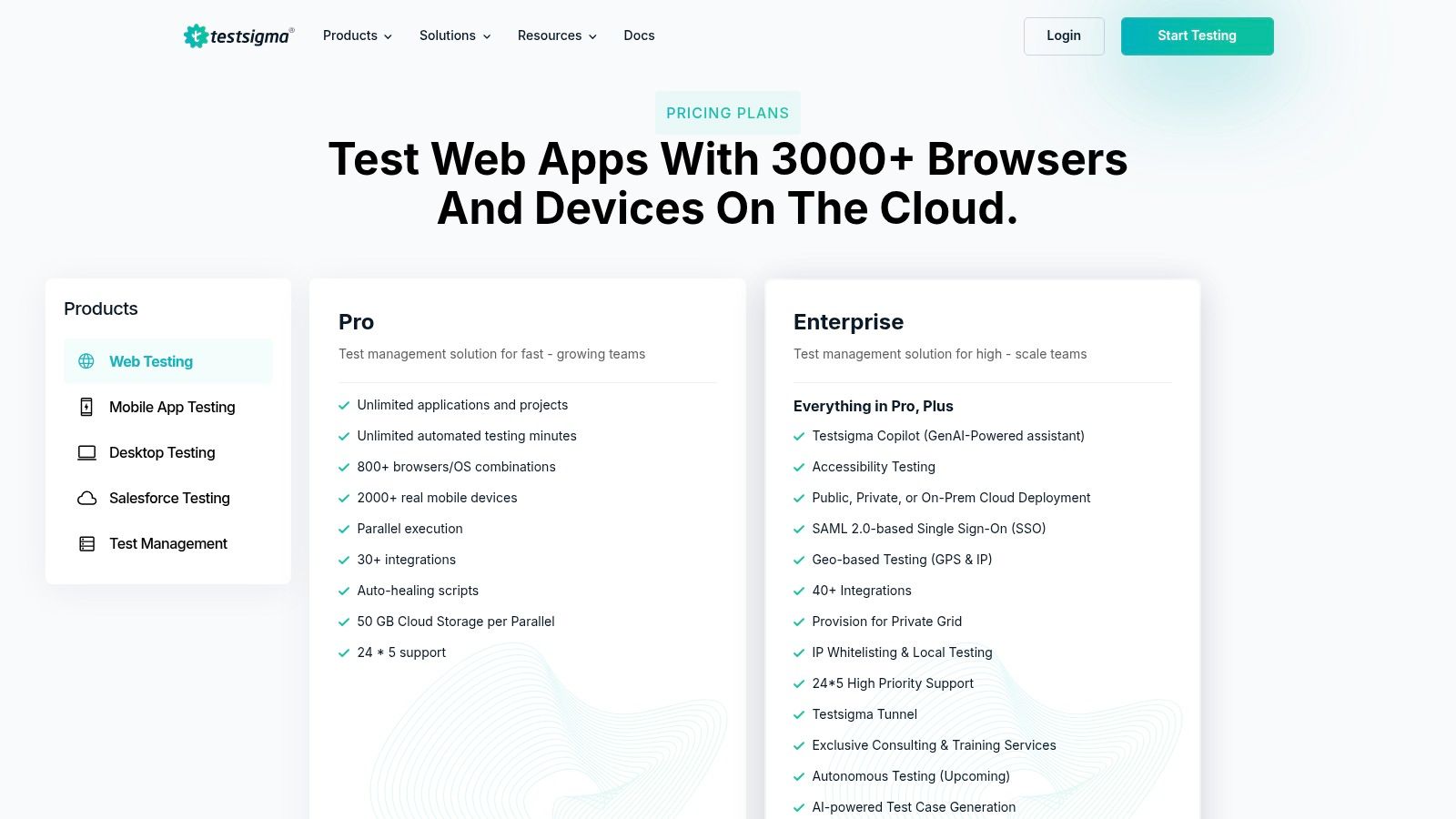
The platform's AI extends to self-healing capabilities, where it automatically identifies and corrects locators in response to UI changes, a common source of test flakiness. With access to thousands of real devices and browsers, extensive integration options, and security features like SSO and secure tunnelling for testing internal applications, Testsigma is built to scale from small teams to large, security-conscious enterprises. Its support for on-premise and private cloud deployments provides the flexibility required by organisations with strict data governance policies.
Key Considerations
- Best Suited For: Enterprise QA teams that need a single tool to cover web, mobile, and API testing, especially in regulated industries requiring secure, on-premise or private cloud options. It's also ideal for teams aiming to empower manual testers with automation.
- Pricing Model: Testsigma offers a free tier for small projects. Its Pro and Enterprise plans are quote-based, which means you need to contact sales for pricing. This model is common for enterprise software but can be a hurdle for teams wanting immediate, transparent cost information.
- Implementation Tip: Begin by using the GenAI Copilot to automate a complex end-to-end test that spans both a web and mobile interface. This showcases Testsigma's cross-platform capabilities and the efficiency gains from its NLP-based test creation, providing a strong business case for wider adoption.
Website: https://testsigma.com/pricing?utm_source=openai
6. Katalon Platform
Katalon Platform provides a comprehensive low-code and no-code test automation solution, embedding AI features to streamline test creation and maintenance. Its self-healing mechanism automatically updates test scripts when UI elements change, significantly reducing the flakiness and manual effort often associated with test maintenance. This makes it a compelling choice for teams looking to accelerate their automation journey without requiring deep programming expertise, positioning it as one of the most accessible ai testing tools on the market.
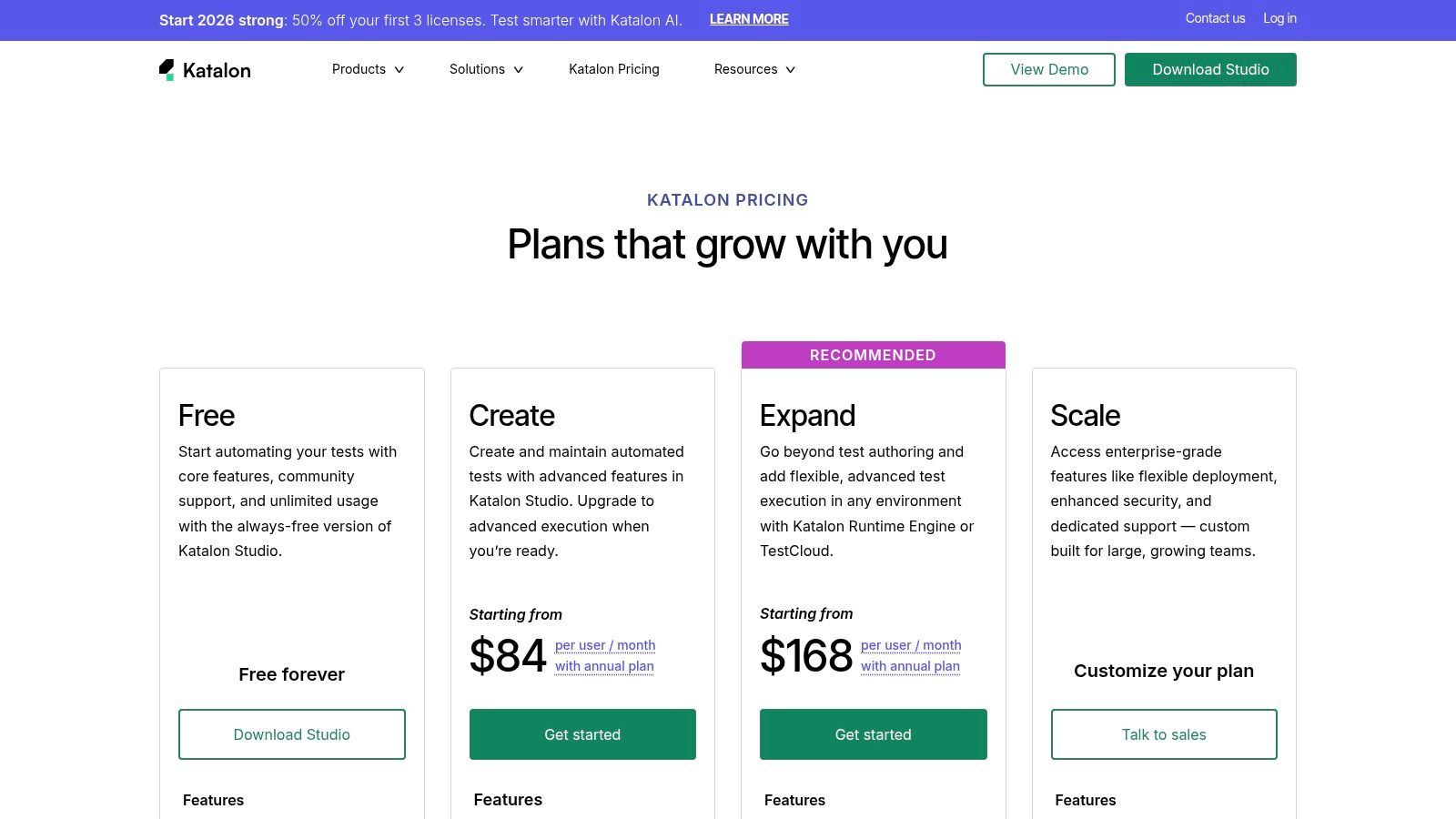
The platform is designed for flexibility, allowing users to author tests in a no-code interface with AI assistance and then execute them across various environments. Teams can run tests locally, on Katalon's TestCloud infrastructure, or within their own private cloud, offering control and scalability. With its strong documentation, academy resources, and a free tier to get started, Katalon effectively lowers the barrier to entry for robust, AI-enhanced test automation.
Key Considerations
- Best Suited For: Small to medium-sized businesses (SMBs) and teams with a mix of technical and non-technical testers. Its clear entry pricing and extensive learning resources are ideal for organisations looking for a structured path into test automation without a massive initial investment.
- Pricing Model: Katalon offers a free tier for basic use. Paid plans are typically bundled, combining the Studio IDE with execution engines (Runtime Engine for on-premise, TestCloud for cloud). Advanced features and higher concurrency often require purchasing these add-ons, which can increase costs as scaling needs grow.
- Implementation Tip: Begin by using the free version of Katalon Studio to automate a few core regression tests. Leverage the record-and-playback and manual view to build confidence, then explore the AI-powered self-healing feature on a part of your application that changes frequently to demonstrate its value in reducing test maintenance.
Website: https://katalon.com/pricing?utm_source=openai
7. Tricentis Testim
Tricentis Testim leverages AI for rapid, low-code test automation, with a strong focus on stability and specialised support for Salesforce applications. The platform allows teams to author tests by recording user journeys, using plain-English descriptions, or a combination of both. Its core AI engine excels at creating smart locators that adapt to application changes, significantly reducing the maintenance overhead associated with brittle selectors and making it one of the more resilient ai testing tools available.
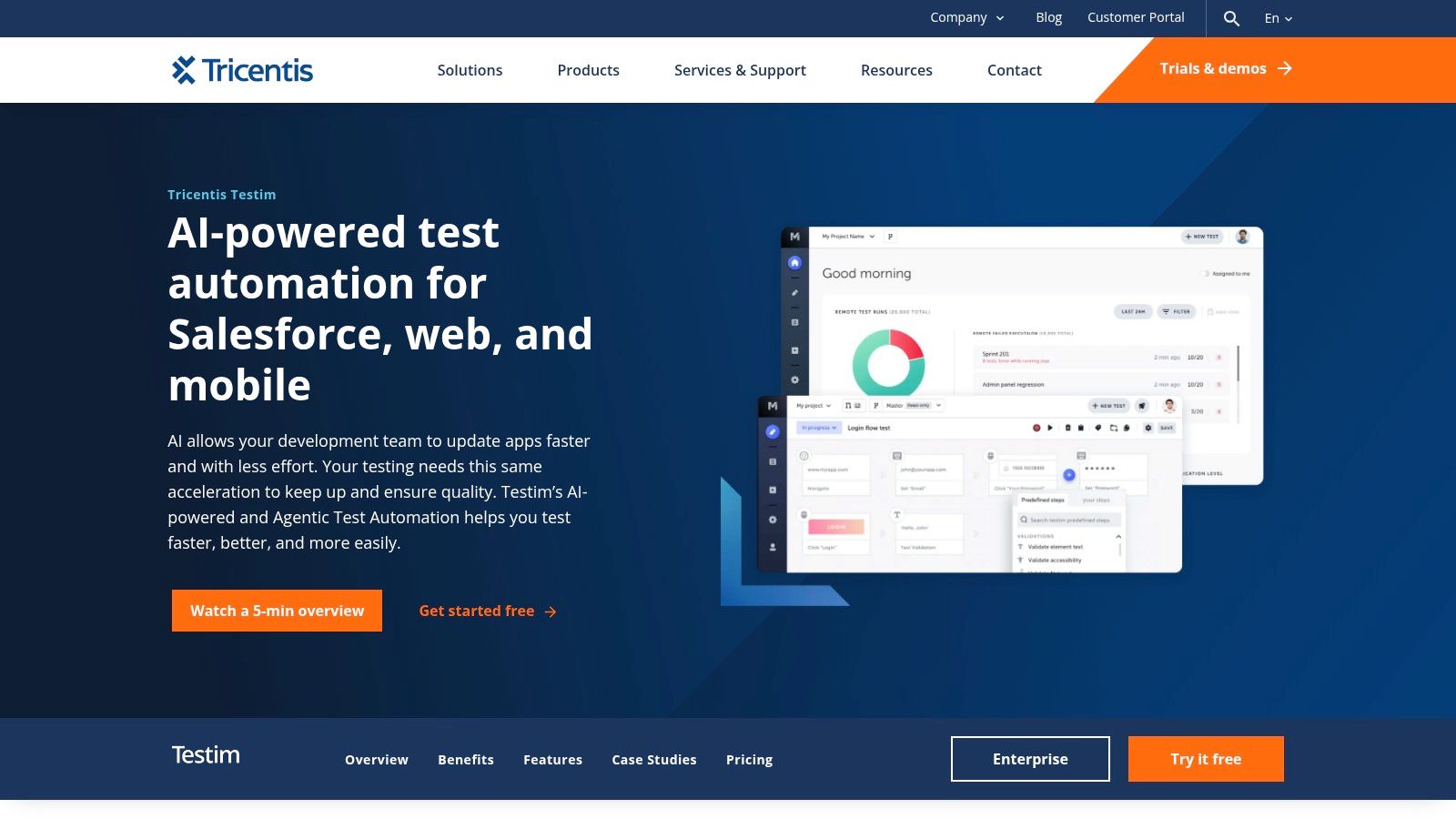
This self-healing capability is a key differentiator, particularly for teams working with dynamic applications. For organisations building on Salesforce, Testim provides purpose-built features, including Lightning-aware locators and predefined steps for common Salesforce components. This specialised support simplifies the otherwise complex task of automating tests for Salesforce's unique architecture, allowing teams to achieve reliable test coverage much faster than with generic frameworks.
Key Considerations
- Best Suited For: Teams that heavily rely on Salesforce and need a robust, low-maintenance automation solution. It's also a strong choice for QA teams transitioning from manual to automated testing who require a fast authoring experience with AI assistance.
- Pricing Model: Tricentis does not list pricing publicly; interested teams must contact their sales department for a custom quote. This approach allows them to tailor packages to specific organisational needs but makes initial budget estimation difficult without direct engagement.
- Implementation Tip: Start by targeting a critical workflow within your Salesforce instance. Utilise Testim's recorder to quickly generate a baseline test, then refine it with the editor to see how the smart locators and self-healing features handle common UI changes during development sprints.
Website: https://www.tricentis.com/products/test-automation-web-apps-testim?utm_source=openai
8. BrowserStack
BrowserStack is renowned for its massive real device and browser cloud, but it has significantly expanded its offering to include powerful AI capabilities. Its primary strength lies in providing unparalleled cross-browser and cross-device testing coverage, now augmented with AI for smarter test execution and visual validation. The platform integrates Percy for AI-powered visual testing, which uses computer vision to detect meaningful UI changes, and also offers AI agents for test case generation, self-healing scripts, and intelligent test selection, making it a comprehensive solution.
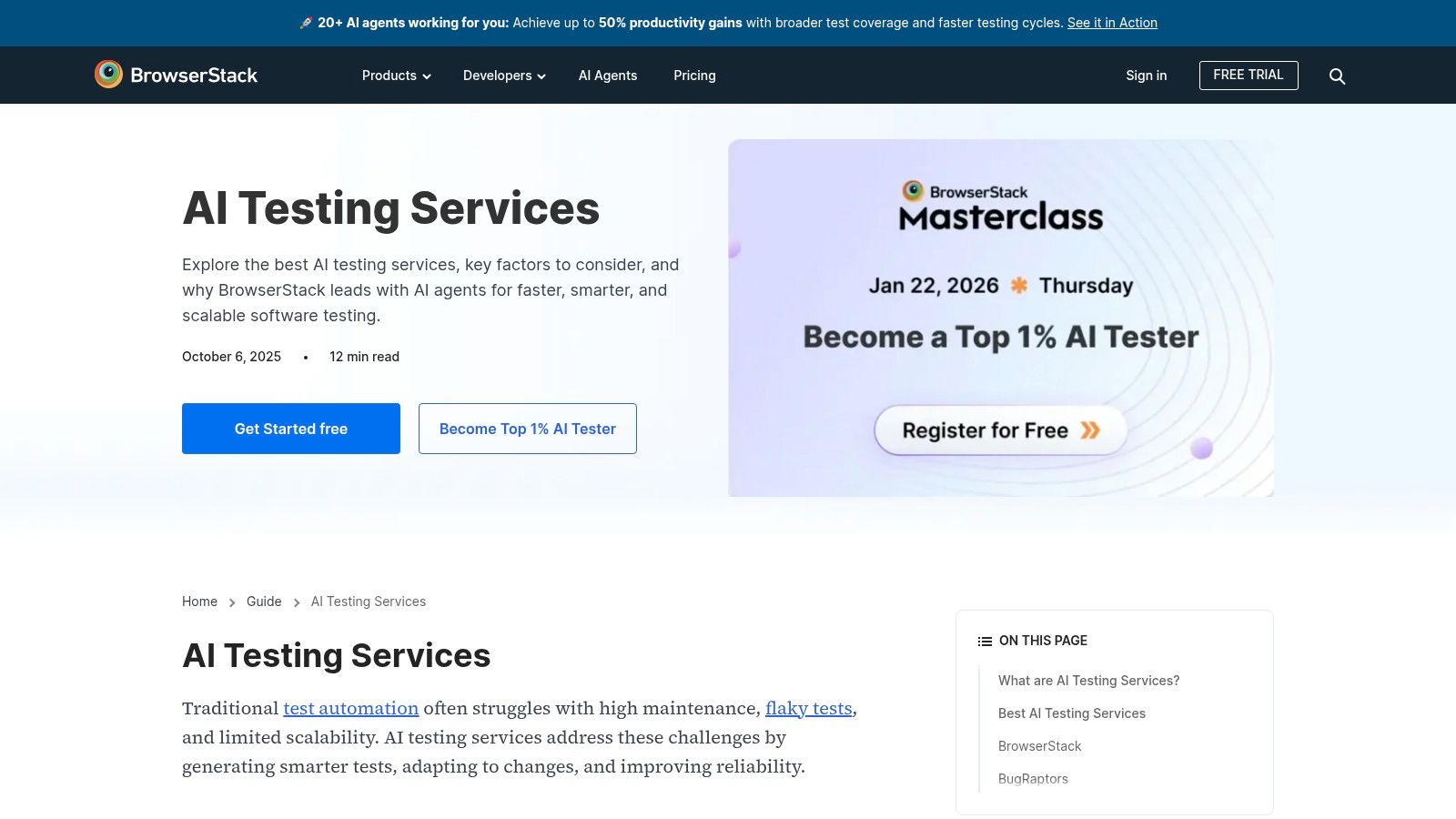
This makes BrowserStack one of the most versatile ai testing tools for teams needing to validate application behaviour and appearance across a vast landscape of user environments. The ability to combine traditional automated testing on over 30,000 real device-browser combinations with intelligent visual checks and test optimisation provides a holistic quality assurance strategy. Its seamless integration with popular CI/CD tools ensures that these extensive checks can be embedded directly into the development pipeline.
Key Considerations
- Best Suited For: Teams requiring extensive device and browser test coverage who want to layer in AI efficiencies without overhauling their existing test frameworks. Organisations looking for an all-in-one platform for functional, visual, and performance testing.
- Pricing Model: BrowserStack offers transparent, self-serve plans for its different products (Live, Automate, Percy). Costs are typically based on the number of parallel tests you need to run simultaneously. While this makes it easy to start, high-concurrency needs for large-scale test runs can become expensive.
- Implementation Tip: Start by migrating a small portion of your existing Selenium or Cypress test suite to run on BrowserStack's cloud. Once functional tests are stable, integrate Percy into the same CI/CD job to add visual testing with minimal effort, immediately demonstrating the value of catching UI bugs.
Website: https://www.browserstack.com/guide/ai-testing-services?utm_source=openai
9. LambdaTest
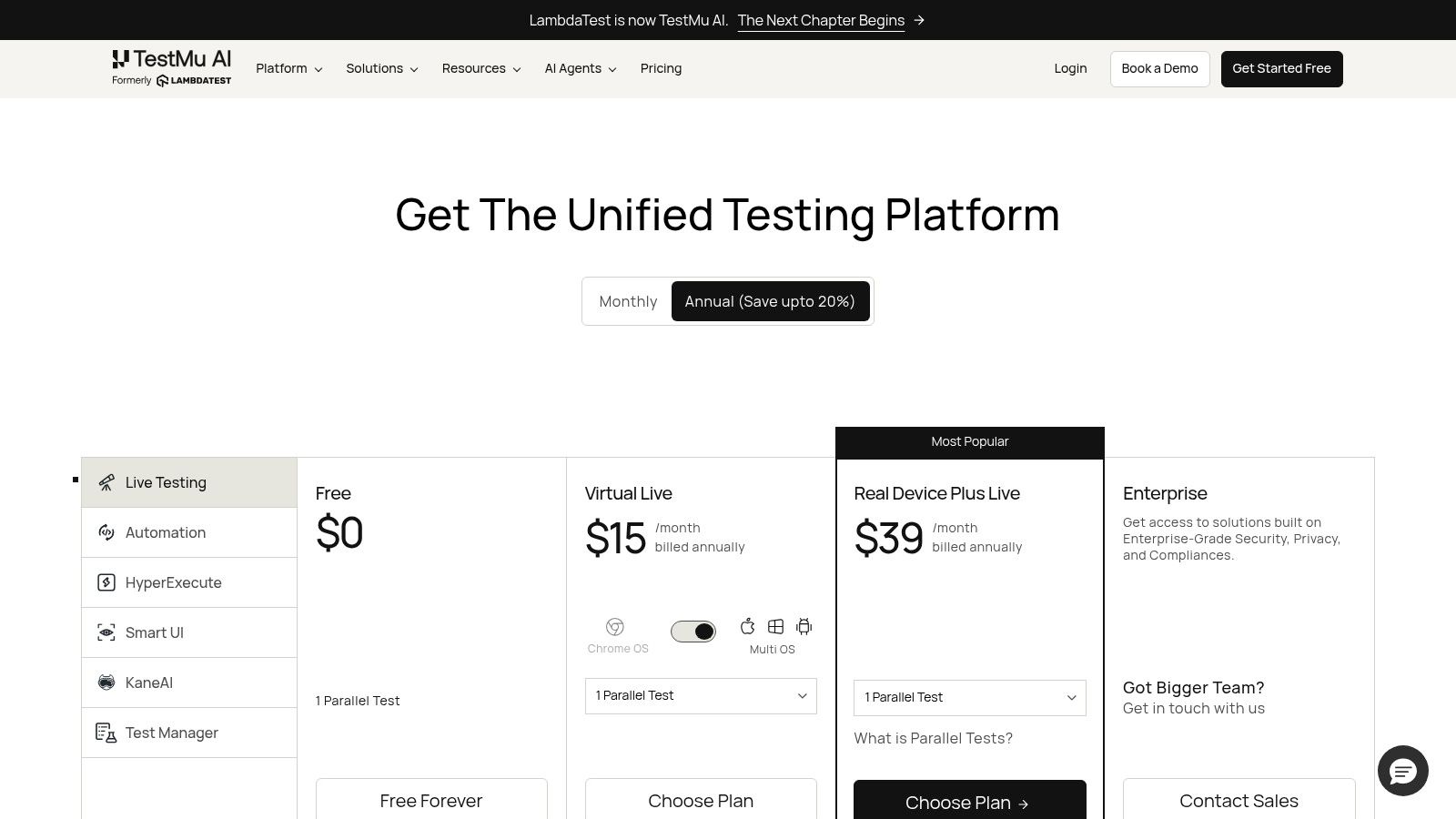
LambdaTest is a comprehensive cloud-based platform that facilitates cross-browser and device testing at scale. While traditionally known for its extensive grid of real browsers and devices, it has integrated AI-driven capabilities through its TestMu AI suite. This makes it a powerful option for teams needing both broad test coverage and intelligent test optimisation. The platform's AI features are designed to enhance existing test scripts by identifying flaky tests, optimising test execution order, and providing deep analytics into test failures, making it a valuable addition to the modern ai testing tools landscape.
Its core value proposition is combining a massive, scalable testing infrastructure with AI-powered analytics and smart features. Teams can run their existing Selenium, Cypress, or Playwright tests in parallel across thousands of configurations, while TestMu AI works in the background to improve stability and reduce maintenance. This integrated approach allows organisations to scale their test automation efforts efficiently without needing to build or maintain their own complex infrastructure.
Key Considerations
- Best Suited For: Startups and small to medium-sized businesses that need a scalable, cloud-based testing grid with an accessible entry point. Its always-free plan is ideal for individual developers or teams just beginning their automation journey.
- Pricing Model: LambdaTest offers a freemium model with a generous, always-free tier for light usage. Paid plans scale based on the number of parallel test sessions required, offering flexibility for growing teams. However, costs can increase as more concurrency and add-on features like real device testing are needed.
- Implementation Tip: Begin by migrating a small subset of your most critical cross-browser tests to the LambdaTest free tier. Use this to validate your test scripts on their platform and evaluate the performance of their cloud grid before committing to a paid plan for parallel execution.
Website: https://www.lambdatest.com/pricing?utm_source=openai
10. Sauce Labs
Sauce Labs is a veteran in the cloud-based testing space, renowned for its extensive cross-browser and real device testing grid. While traditionally focused on providing infrastructure, its recent integration of AI through Sauce Visual brings visual regression testing capabilities into its robust platform. This positions it as a comprehensive solution for teams needing to validate both functionality and appearance across a massive array of browsers, operating systems, and real mobile devices, making it one of the most versatile ai testing tools for large-scale QA operations.
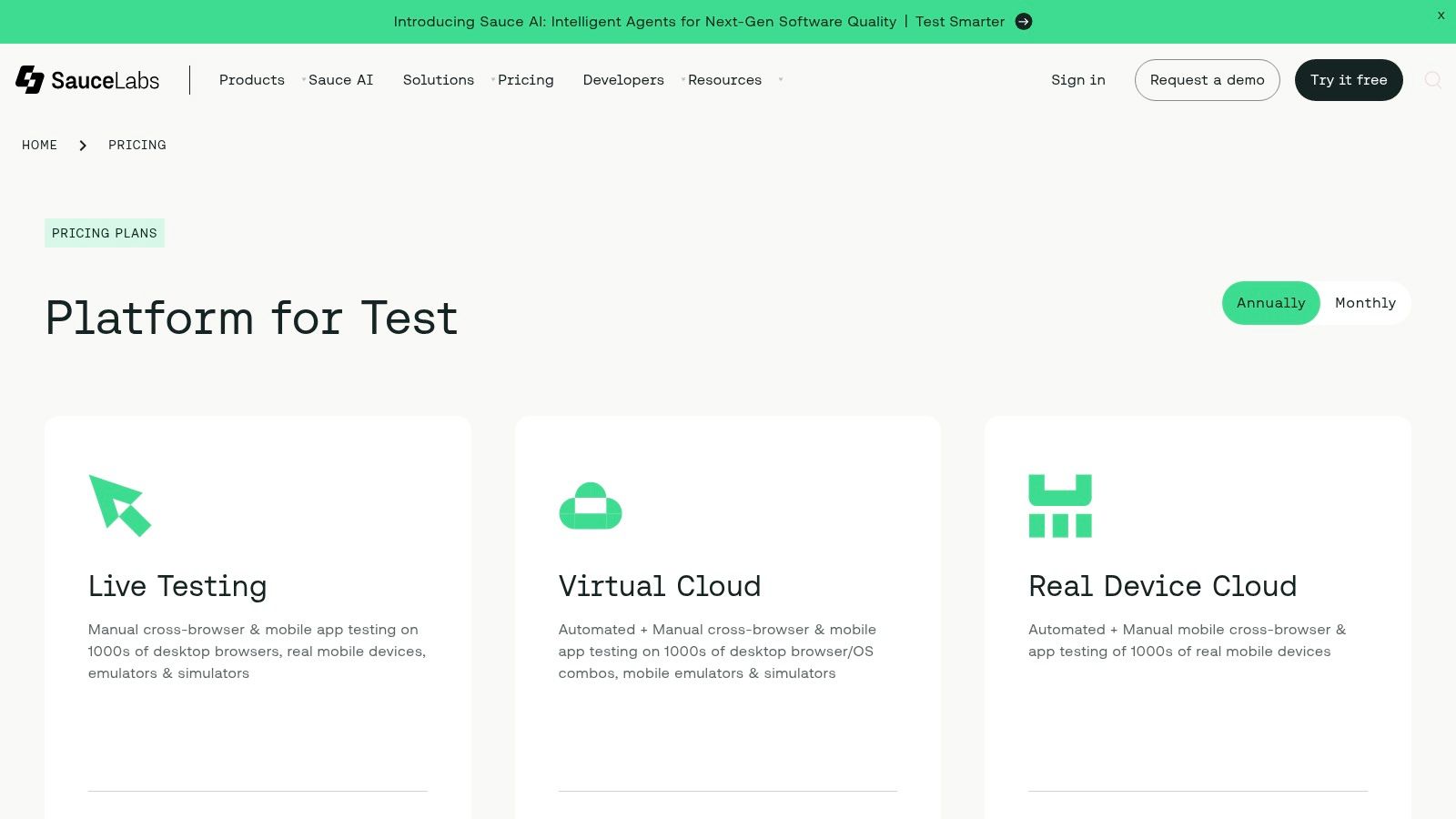
The platform excels at providing deep debugging insights, offering detailed test execution videos, logs, and network performance data. This is crucial for quickly diagnosing failures that occur on specific device or browser combinations. By combining this deep diagnostic capability with Sauce Visual's AI-powered screen comparisons, teams can manage complex, high-volume test suites that cover both functional correctness and visual perfection in a single, unified workflow.
Key Considerations
- Best Suited For: Enterprise QA teams and organisations that require extensive test coverage across a wide matrix of real devices and browsers. Its debugging tools are invaluable for pinpointing environment-specific bugs.
- Pricing Model: Offers clear self-serve pricing for individuals and small teams, which is a significant advantage for getting started quickly. Paid plans typically include unlimited testing minutes, but parallelism is the primary scaling factor, which can become a bottleneck on lower tiers.
- Implementation Tip: Leverage the Sauce Labs REST API to integrate test results directly into your CI/CD pipeline and reporting tools like Slack. This creates a tight feedback loop, ensuring that environment-specific failures are flagged and reviewed by the development team immediately.
Website: https://saucelabs-prod.vercel.app/pricing?utm_source=openai
11. Reflect (SmartBear)
Reflect, now part of the SmartBear suite, offers a no-code, cloud-based test recording platform designed for speed and simplicity. Its standout feature is an intelligent recorder that requires no browser extensions or installation, allowing users to start building tests immediately. The platform leverages AI to improve the resilience of element selectors, automatically identifying the best attributes to target and reducing the maintenance burden often associated with brittle locators. This makes it one of the most accessible ai testing tools for teams wanting to move quickly from manual testing to automation without a steep learning curve.
 pricing table showing its credit-based model.](https://cdn.outrank.so/1365d92d-e2c4-4b0d-8a9a-6d0e2db08842/screenshots/da1bddf4-866c-483a-a5ea-4114ff886da0/ai-testing-tools-pricing-table.jpg)
Beyond web recording, Reflect natively handles multi-step tests involving email and SMS verification, a common requirement for modern user flows like sign-ups and password resets. Each test run provides detailed artifacts, including video recordings, network logs, and console outputs, which streamlines debugging. With its straightforward, credits-based execution model and CI/CD integrations, Reflect is optimised for smaller teams and individual developers who need a powerful, low-overhead solution for end-to-end testing.
Key Considerations
- Best Suited For: Small engineering teams, indie makers, and QA professionals looking for a fast, no-install solution. Its ease of use makes it ideal for organisations introducing their first automated testing framework.
- Pricing Model: Reflect uses a credits-based system where one credit equals one test run. Plans are tiered by the number of included credits and parallel test executions. While this model is transparent, scaling for heavy mobile parallelism or enterprise-level test volume may require moving to higher-cost plans.
- Implementation Tip: Begin by using the cloud recorder on a core user journey, like user registration or checkout. The detailed video and log outputs from these initial runs are excellent for demonstrating the tool's value in pinpointing front-end bugs to the wider team.
Website: https://reflect.run/pricing/?utm_source=openai
12. Autify
Autify positions itself as a flexible, no-code testing platform enhanced with Generative AI capabilities. Its core value proposition lies in making test automation accessible to teams of all sizes through a user-friendly interface, while still offering powerful features like Playwright code import/export for more technical users. The platform's self-healing AI adapts to UI changes, reducing the maintenance burden and making it a practical choice among ai testing tools for fast-moving development cycles.
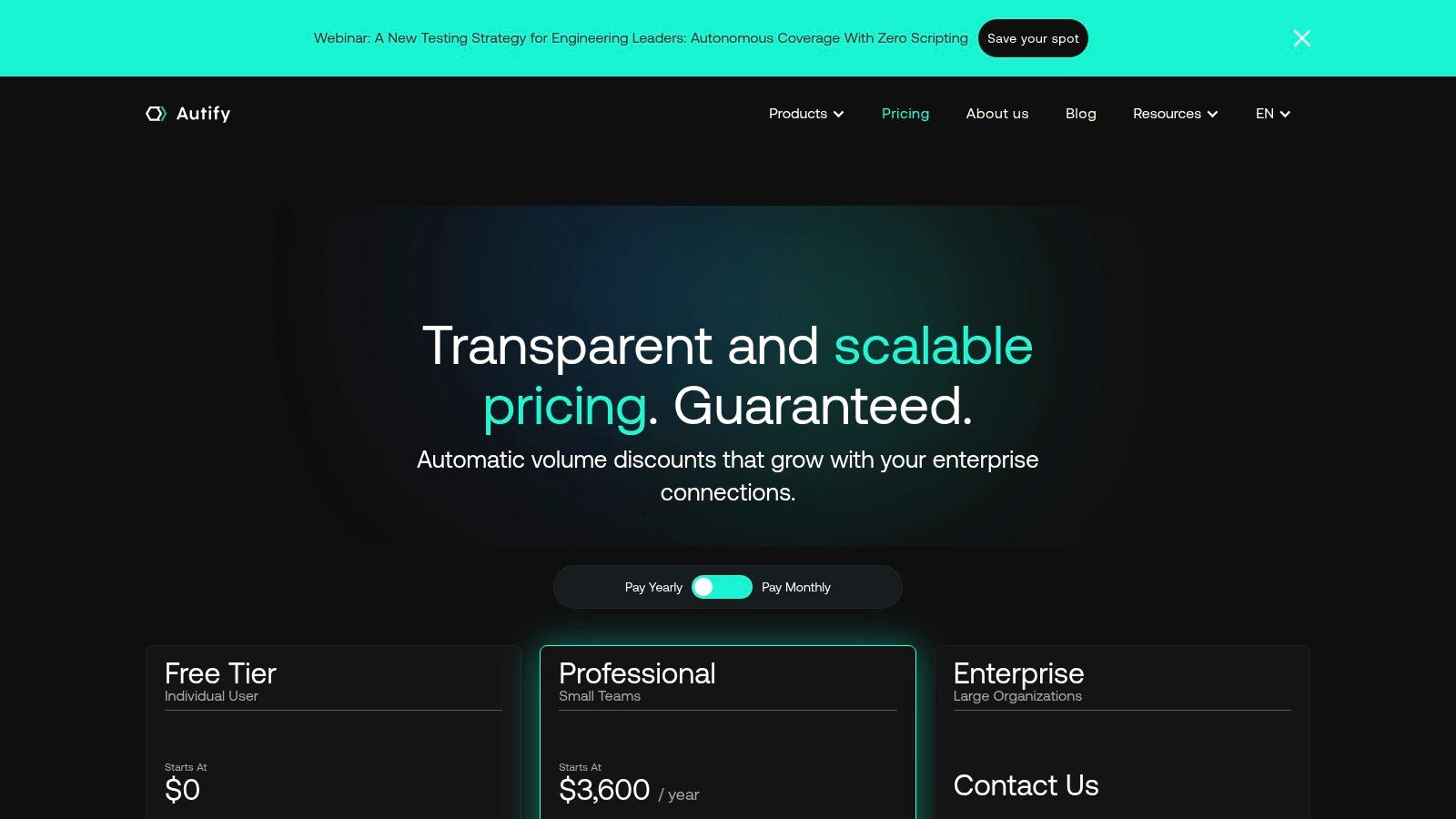
The platform’s standout feature is its modular pricing and execution model. It offers a free tier for local test execution, allowing teams to validate its capabilities without initial investment. As needs grow, users can add cloud-based parallel executions and advanced AI features as paid add-ons. This flexibility, combined with its CI and API integrations, allows Autify to scale from a simple tool for manual QA to a fully integrated component of a DevOps pipeline.
Key Considerations
- Best Suited For: Teams transitioning from manual to automated testing, organisations needing a low-code solution with the option for code-based flexibility, and startups wanting to start testing for free and scale their investment as they grow.
- Pricing Model: Autify offers a free tier for local execution, with paid plans that scale per user. Key features like cloud parallel tests, visual regression, and some GenAI capabilities are available as flexible add-ons, allowing for a customised pricing structure.
- Implementation Tip: Begin with the free local execution tier to automate a core user journey. Use the Playwright export feature to show developers how the no-code interface generates clean, maintainable code, which can help bridge the gap between QA and engineering teams.
Website: https://autify.com/pricing?utm_source=openai
Top 12 AI Testing Tools: Feature Comparison
| Product | Core features | Quality / UX (★) | Value / Pricing (💰) | Target audience (👥) | Unique selling points (✨) |
|---|---|---|---|---|---|
| e2eAgent.io 🏆 | No-code natural‑language tests; runs in real Chromium; video/screenshots + JSON results | ★★★★☆ — real‑browser, low maintenance | 💰 Pilot / waitlist — no public pricing | 👥 Startups, small SaaS teams, QA leads, DevOps | ✨ NL-only authoring; AI resilience to UI changes; CI‑friendly artifacts |
| Applitools | Visual AI + Autonomous/NLP authoring; 30+ SDKs; execution cloud options | ★★★★★ — visual accuracy & stability | 💰 Test‑unit model; scalable / quote | 👥 Visual‑regression teams, enterprises | ✨ Best‑in‑class visual diffs; wide SDK coverage |
| mabl | Low‑code + GenAI features; auto‑healing; cross‑browser/mobile; generous runs | ★★★★☆ — good onboarding & diagnostics | 💰 Quote‑based; packaging varies | 👥 Small QA teams, SMBs | ✨ GenAI auto‑healing; strong onboarding & concurrency |
| Functionize | AI/NLP authoring; self‑healing; orchestration & analytics; enterprise controls | ★★★★☆ — enterprise scale & governance | 💰 Enterprise / quote | 👥 Large enterprises, test ops teams | ✨ Orchestration + deep analytics for big suites |
| Testsigma | NLP/GenAI Copilot; auto‑healing; thousands of browsers/devices; 30+ integrations | ★★★★☆ — broad platform support | 💰 Pro/Enterprise quote‑based | 👥 SMBs → enterprises needing secure testing | ✨ Broad device coverage + enterprise security options |
| Katalon Platform | No/low‑code with AI assistance; self‑healing; local/cloud/private execution | ★★★★ — free tier & strong docs | 💰 Free tier + paid add‑ons | 👥 SMBs, teams starting automation, learners | ✨ Free entry tier + extensive learning resources |
| Tricentis Testim | Agentic AI test gen; NL authoring; Salesforce steps; TestOps integrations | ★★★★ — fast test creation | 💰 Contact vendor (quote) | 👥 Salesforce teams, rapid automation needs | ✨ Salesforce‑aware locators & native TestOps |
| BrowserStack | Massive real device/browser cloud; AI agents; Percy visual testing | ★★★★☆ — fast onboarding, broad coverage | 💰 Transparent self‑serve plans (Live/Automate/Percy) | 👥 Teams needing global device coverage | ✨ Huge device matrix + Percy integration |
| LambdaTest | Cloud grid + TestMu AI; parallel sessions; real devices & emulators | ★★★★ — cost‑competitive | 💰 Freemium + scalable parallel pricing | 👥 Startups & cost‑conscious teams | ✨ Always‑free starter plan; flexible parallel scaling |
| Sauce Labs | Cross‑browser & real devices; visual testing; videos/logs & secure tunnels | ★★★★ — robust debugging | 💰 Clear self‑serve pricing; enterprise tiers | 👥 Teams needing strong debugging & device support | ✨ Rich logs/videos + reliable device cloud |
| Reflect (SmartBear) | No‑code cloud recorder; AI element targeting; credits‑based execution | ★★★ — fast onboarding for small teams | 💰 Credits model; team/paid plans | 👥 Indie makers, small engineering teams | ✨ No‑install recorder + simple credits billing |
| Autify | GenAI‑assisted steps; local free execution; Playwright import/export; visual checks | ★★★ — flexible local/cloud mix | 💰 Free local tier + paid cloud add‑ons | 👥 Teams validating locally; migrating Playwright users | ✨ Playwright import/export + local free tier |
Final Thoughts
Navigating the landscape of AI testing tools can feel like a formidable task, but the potential rewards for your development lifecycle are immense. We've explored a dozen powerful platforms, from intelligent agents like e2eAgent.io that execute plain-English commands, to visual validation specialists like Applitools and enterprise-grade solutions such as Katalon and Tricentis Testim. The common thread weaving through all these tools is a fundamental shift away from brittle, code-heavy test scripts towards more intelligent, resilient, and accessible automation.
The core takeaway is that artificial intelligence is no longer a futuristic concept in software testing; it is a practical, present-day solution to long-standing challenges. AI-driven features like self-healing tests, autonomous test generation, and visual anomaly detection directly combat the maintenance overhead that has historically plagued test automation efforts. This allows your team to focus less on fixing broken tests and more on delivering a high-quality user experience.
Choosing Your Path Forward
Selecting the right tool is less about finding a single "best" option and more about aligning a platform's strengths with your team's specific context and goals. Your decision-making process should be a strategic exercise, not just a technical one.
To guide your selection, consider these critical questions:
- What is our team's technical skill level? If your team primarily consists of manual testers, product managers, or those less comfortable with coding, tools like e2eAgent.io, mabl, or Autify, which prioritise natural language or low-code interfaces, will offer the fastest path to value. Teams with strong engineering skills might gravitate towards platforms like Testsigma or Katalon that offer greater scripting flexibility alongside AI enhancements.
- What is our biggest testing bottleneck? Is it the sheer time it takes to write and maintain tests? Look for autonomous generation and self-healing. Is it catching subtle visual regressions across countless devices? Visual AI platforms like Applitools or the visual testing features within BrowserStack are your answer. Is it achieving broad cross-browser coverage without managing a device lab? Cloud-based grids from LambdaTest or Sauce Labs are essential.
- How will this tool integrate with our existing workflow? Seamless CI/CD integration is non-negotiable. Ensure your chosen tool has robust, well-documented integrations with your specific pipeline tools, whether it's GitHub Actions, Jenkins, or CircleCI. Also, consider integrations with project management tools like Jira or communication platforms like Slack for streamlined feedback loops.
A Phased Approach to Implementation
Once you've shortlisted a few candidates, avoid a "big bang" rollout. The most successful adoptions of AI testing tools follow a measured, pilot-based approach.
- Define a Pilot Project: Choose a small, well-defined, yet critical user flow within your application. This could be the user registration and login process or a core checkout sequence.
- Set Clear Success Metrics: What does success look like for this pilot? It could be reducing the time to create a test suite by 50%, decreasing test failures due to locator changes by 75%, or enabling a non-technical team member to create and run tests independently.
- Evaluate and Iterate: After the pilot, gather feedback from everyone involved. Did the tool live up to its promises? Was the learning curve manageable? The insights gained here are invaluable for making a final decision and planning a broader, organisation-wide implementation.
The journey into AI-powered testing is an investment in your product's quality and your team's efficiency. By moving beyond traditional, fragile automation, you are building a more robust, adaptable, and intelligent quality assurance process that can keep pace with the demands of modern software development.
Ready to experience the future of test automation firsthand? If you're looking for one of the simplest yet most powerful ai testing tools that lets your entire team contribute to quality using plain English, give e2eAgent.io a try. See for yourself how an intelligent agent can understand your user stories and execute them flawlessly in a real browser. Visit e2eAgent.io to start your free trial today.